
Trending
This story is from August 31, 2011
Celebrating the modak-loving wise one
For Hindus across the globe, he is the supreme god of wisdom and prosperity.


To understand the celebration, however, a bit about Lord Ganesha should be known. There are numerous stories in Hindu mythology associated with his birth.
A god takes form
Legend has it that Parvati (Lord Shiva's consort) created Ganesha out of the sandalwood dough that she used for her bath and breathed life into him. Another version, however, says that once, while bathing, Goddess Parvati created a human figure from some unguent and balm, infused in him life and asked him to guard the door while she bathed. Lord Shiva, who was meditating on Mount Kailash, coincidentally chose that very moment to meet his consort at her abode. The boy, posted by Parvati at the door, stopped him at the entrance. Outraged and having no idea that it was his own son stopping him, Lord Shiva-the God of destruction-severed the lad's head. A distraught Parvati wailed and appealed to Lord Shiva to revive the boy. Feeling the unbearable pain of Parvati for the son, Lord Shiva dispatched his attendants (ganas) to get him the head of the first living creature they could find on their way. The attendants came across an elephant, the first living creature before them. As directed, they chopped off its head and brought it back to Shiva, who fixed it onto the boy's body thereby infusing into him fresh life. Ever since then the lad has been named Ganesha or Ganapati, the chief of Shiva's ganas.
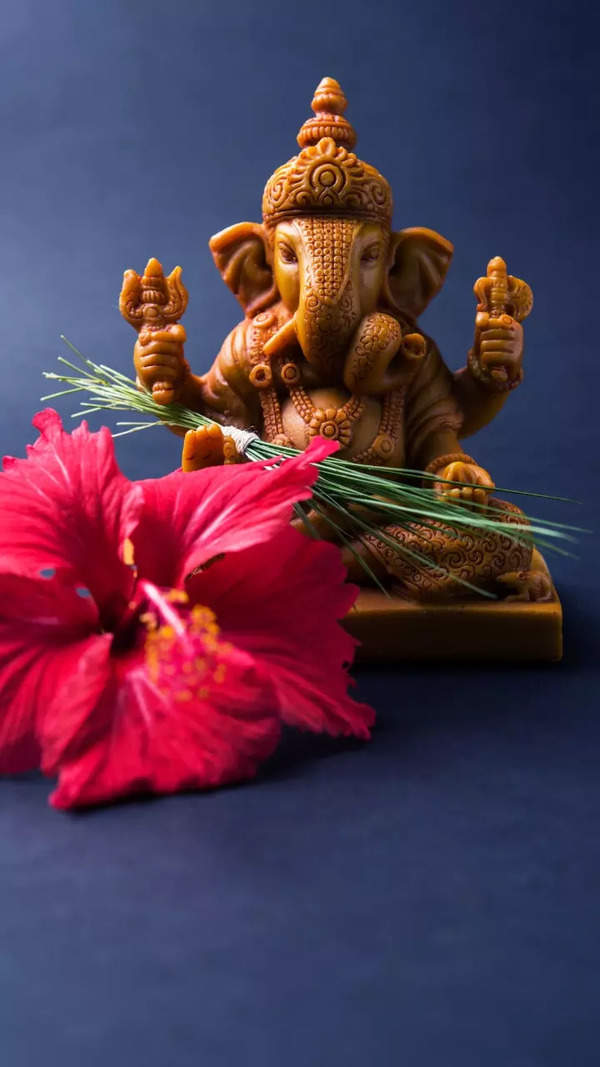
Ganesha has four hands in which he holds a trident (trishul), ankush (goad made from his own broken tooth), lotus and a rosary (which is sometimes replaced by his favourite droplet-shaped sweet, modak).
When wit won
Another interesting tale tells of how he came to be known as the leader of ganas (Ganadhipati or Ganapati). Once the gods decided to choose their leader and arranged a race between Lord Ganesha and his brother Kartikeya-the general of the gods. Whoever took three rounds of the earth first would be made Ganadhipati or their leader. Kartikeya set off on his peacock vehicle to meet the challenge, while Ganesha embarked on his mooshak (rat). Among Hindus, it is a strong belief that one's parents are the embodiment of the universe, and an obeisance to them fulfills all uphill tasks. For Ganesha, his parents constituted the earth, and as such instead of going around the earth, he went around them three times and completed the task before Kartikeya. Ganesha's wit pleased one and all and he soon came to be known as the Ganadhipati.
Blue moon
Ganesha's curse to the moon is well-known in mythology and strictly adhered to by devotees on the day of Chaturthi. On the occasion of one of his birthdays, Goddess Parvati prepared delicious food including modaks. Ganesha ate the food, his stomach stuffed. He then embarked on his mooshak to move around paradise. On his way, mooshak came across a snake and stumbled. Without wasting time, Ganesha tied the snake as a belt around his stomach. Seeing the sorry plight of the stumbling mooshak, the moon could not control his laughter. Ganesha became furious and in a fit of rage he broke off one of his tusks and hurled it at the moon. He also cursed the moon that whoever looks at it will be accused of a wrongdoing. However, the moon pleaded before Lord Ganesha and urged him to take back his curse. Ganesha pardoned the moon and said the curse would be effective only on Ganesh Chaturthi. The tradition is still followed by most Hindus.
End of Article
FOLLOW US ON SOCIAL MEDIA





Hot Picks
TOP TRENDING
Trending Stories
In City
Entire Website
- 'We were treated like slaves, made to work for 15 hours a day': Tricked into Ukraine war, 3 from Karnataka return home
- 'My father was on the flight': Jaishankar opens up about 1984 Air India hijack
- Airtel CEO Gopal Vittal sends letter to Reliance Jio, Vodafone-Idea, Tata Tele and BSNL CEOs; here's what he said
- Prince Harry to celebrate 40th birthday away from Meghan Markle
- Haitian immigrant pet-eating row: Ohio woman accused of eating cat is US citizen, video is not from Springfield
- Kejriwal out of jail; 'CBI arrest only to frustrate ED case bail': SC judge
- Donald Trump reveals what Laura Loomer is to his campaign: 'I don't control her'
- Hamster Kombat Daily Cipher Codes and Combo Cards for September 14, 2024: Unlock up to 1 million coins
- Laura Loomer's photo with Donald Trump viral. People ask where's Melania, where's wedding ring
- Garena Free Fire MAX redeem codes for September 13: Win in-game goodies and rewards
- 'Were ready for no recording but ... ': Docs leave Mamata's home as another meet fails
- 'Nafrat ki dukaan pe ...': PM Modi attacks Congress over 'brutality' in US
- Will Germany’s suspension of Schengen entry end the Europe dream?
- Blast in central Kolkata leaves 1 person injured, area cordoned off
- 'Look at Virat Kohli': Ex-Pak captain wants Babar to...
- Trump defends 'loony' Laura Loomer amid MAGA meltdown
- Why you should not be fooled by ‘20-year SIP crorepati’ dream
- Bengaluru woman sparks controversy with comments about Swiggy delivery executive
- Prashant Kishor vows to end Bihar liquor ban within 60 mins of taking office
- 'Rohit didn't practice as hard as Sachin': Rhodes

Popular Categories
Hot on the Web
Top Trends
Trending Topics
World Largest HorseEID WishesGreen Apple BenefitsPriyanka Chopra TattooKottukkaali OTT ReleaseNarendra ModiGhaziabad Juice SellerHair LossSudha MurtyMalayalam ProducersIndia's Best Dancer 4Simi GarewalDilli BabuIndian National ParksLaung BenefitsVikas SethiApple iPhone 16Donald TrumpAadhar Card UpdateWordle Answer
Living and entertainment
Latest News
Kaun Banega Crorepati 16: Can you guess the answer for this Rs 3,20,000 question on Navy, which contestant Naman Jain incorrectly answered?Ananya Panday urges all industries to form Hema Committee': 'Clearly, no one else is doing it but women'Nine arrested on charges of assaulting a Dalit woman at Kallukunta village in Kurnool district'Calling all Swifties for Trump': Donald's new campaign merch imitates Eras Tour shirtsWWE Hall of Famer Watches 15 Hours Of Wrestling Each WeekDallas Cowboys Set to Defend AT&T Stadium in Week 2 Clash with New Orleans SaintsTovino on training for Kalaripayattu in ‘ARM’: I practiced every single day, even if I had a hectic day on set8 animals that reproduce without matingDelhi Police Files FIR for Firecracker Celebration Outside CM Kejriwal's ResidenceThrowback: When Alia Bhatt responded to insecurity questions about Ranbir Kapoor, shut down gossipIndia's T20I captain Suryakumar Yadav turns 34: A glimpse into his stellar T20 careerThe 3 Strongest Zodiac Signs: Powerhouses of the Zodiac WheelRakul Preet Singh reveals Bollywood stylists charge from Rs 15000 to Rs 1 lakh for one event, one outfit: 'Living in Mumbai requires a lot of PR'Dhruv Kapila's health setback shatters Indian pair's Vietnam Open semifinal hopesFormer Titans Cheerleader Danielle Sekelsky Begins WWE NXT Training"Birthday aapka hug aur paari I am getting...": Tahira Kashyap pens adorable b'day wish for hubby Ayushmann KhurranaRecord-Breaking Viewership for NFL’s 2024 Season KickoffAshish Vidyarthi delves into vocal artistry behind his role as Doctor Doom
Copyright © 2024 Bennett, Coleman & Co. Ltd. All rights reserved. For reprint rights: Times Syndication Service